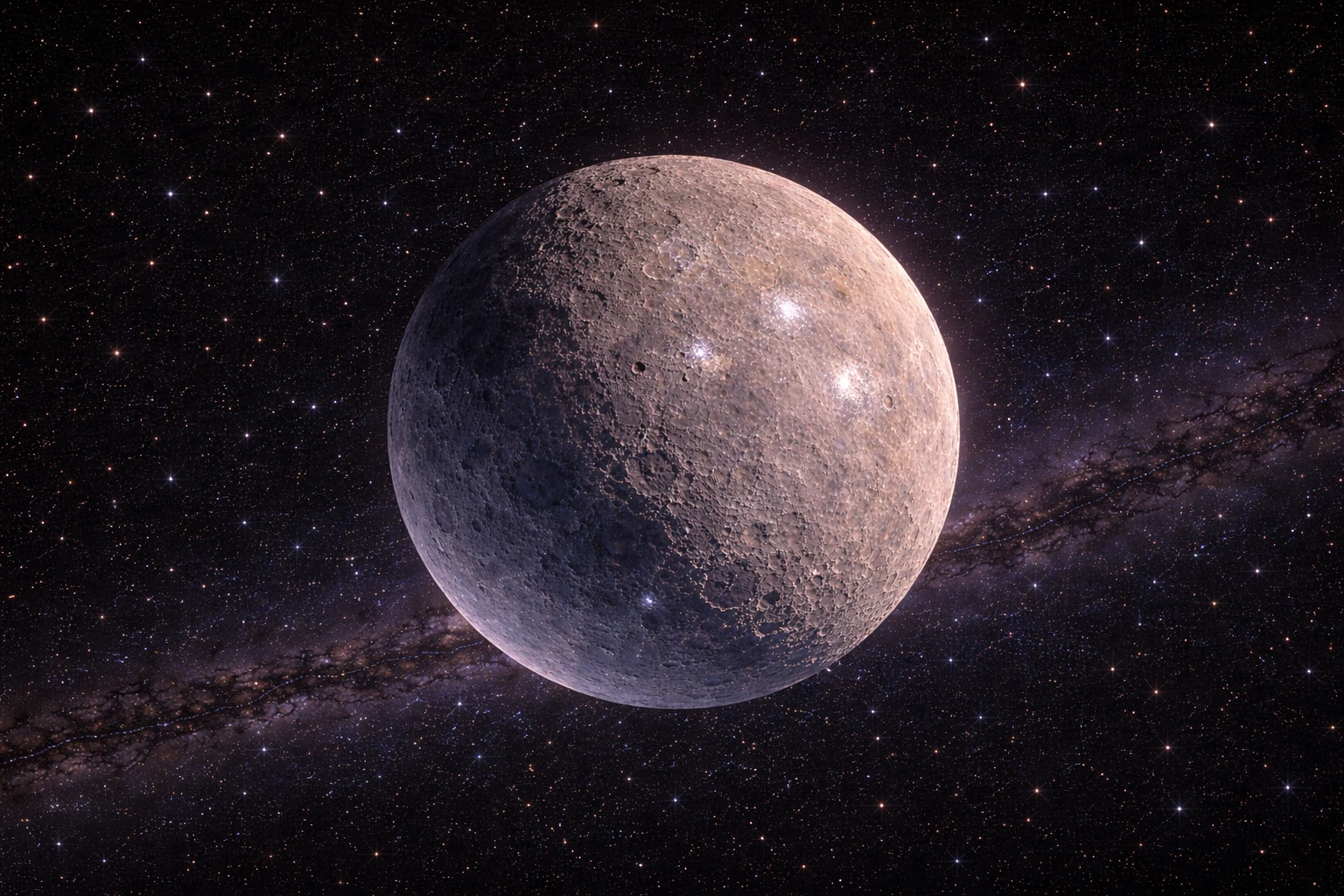
Uranus
Retrograde
Uranus in astrology represents liberation, sudden change, and revolutionary innovation. Learn what Uranus means in your birth chart, transits, and relationships.
Last updated:
Where you break free — your inner revolutionary, your unique genius, and where sudden change transforms your life.
Uranus is the cosmic lightning bolt, the great awakener, the planet that shatters crystallized structures so something new can emerge. Where Saturn builds walls, Uranus tears them down. Where Jupiter expands within existing frameworks, Uranus explodes the framework itself. This is the planetary energy of revolution, innovation, and radical authenticity — the force that says no to conformity and yes to the unprecedented. Understanding Uranus in your chart means understanding where you are meant to be different, where sudden change will periodically upend your life, and where your unique genius waits to be liberated from the prison of convention.
Uranus operates through disruption. It does not reform — it revolutionizes. It does not adjust — it overthrows. When Uranus activates a part of your chart, expect the unexpected. Relationships end abruptly so truer connections can form. Careers implode so authentic vocations can emerge. Beliefs shatter so genuine understanding can dawn. The Uranian experience is often uncomfortable in the moment — we humans generally prefer stability — but it serves liberation. What Uranus destroys was already a cage, even if we had decorated it nicely and called it home. What Uranus awakens was already alive in us, waiting for permission to exist.
Uranus was discovered on March 13, 1781, by William Herschel, and its timing is astrologically significant. This was the age of revolution — the American Revolution was underway, the French Revolution would erupt eight years later, and the Industrial Revolution was transforming how humans lived, worked, and understood their world. Uranus carries the signature of its discovery era: enlightenment over tradition, reason over superstition, individual rights over inherited hierarchies, innovation over repetition. Every outer planet that humanity discovers reflects something that humanity is ready to integrate consciously. Uranus announced that the time for revolution had arrived — not just political revolution, but the ongoing revolution of consciousness that insists each generation can reinvent what it means to be human.
Before Uranus was discovered, Saturn was the outermost known planet and thus the boundary of the known cosmos. Saturn represented limits, endings, and the cold edge of reality. Uranus shattered that boundary. It revealed that there was more beyond the known limits, that the universe was larger than tradition assumed, that something existed beyond the walls of the old world order. This is what Uranus does in your chart: it points to where you can break through Saturn's limits, where something exists beyond what you have been told is possible, where the boundary is actually a doorway.
Uranus is named after the Greek god of the sky, but its astrological meaning draws more from the mythology surrounding that figure than from the deity himself. In myth, Uranus was overthrown by his son Saturn (Kronos), who was in turn overthrown by his son Jupiter (Zeus). This pattern of generational overthrow, of the new replacing the old, of revolution as cosmic law, is the essential Uranian theme. Each generation disrupts the one before it. What was radical becomes conventional, what was conventional becomes obsolete, and a new radicalism arises. Uranus is this principle of perpetual revolution, the understanding that no form is permanent, that consciousness must keep evolving or stagnate.
The Uranian archetype appears throughout human culture: the rebel, the inventor, the eccentric genius, the mad scientist, the revolutionary, the iconoclast, the freethinker. Prometheus, who stole fire from the gods to give to humanity, is a Uranian figure — the one who breaks divine law to advance human freedom and pays the price. Nikola Tesla, with his brilliant and erratic inventions that transformed modern life, embodied Uranian energy. So did every revolutionary who declared that the old order must end, every inventor who saw what others could not imagine, every eccentric who refused to pretend normalcy. Uranus people are often strange by conventional standards, but conventional standards are precisely what Uranus exists to challenge.
Psychologically, Uranus represents the individuation impulse taken to its extreme — the drive not just to be yourself, but to be yourself in ways that break from collective expectations entirely. Where the Sun wants to shine within a context, Uranus wants to shatter the context itself. This is the energy that makes teenagers rebel against parents, that makes artists reject established forms, that makes scientists question accepted theories, that makes anyone anywhere say I will not conform, and I do not care what you think about it.
Healthy Uranus expression manifests as genuine originality, as the courage to follow your own vision regardless of approval, as the capacity to think independently and question inherited assumptions. It is the part of you that knows you are unique and refuses to pretend otherwise. Unhealthy Uranus expression manifests as rebellion for its own sake, as contrarianism without content, as the compulsion to be different that is just as enslaved to convention as conformity — merely inverted. The person who must always disagree, must always shock, must always stand apart is not free; they are still letting convention define them, just negatively. True Uranian freedom is the capacity to conform when conformity makes sense and rebel when rebellion makes sense, based on genuine inner knowing rather than reactive opposition.
Uranus also governs the nervous system, which transmits electrical impulses throughout the body. Uranian people often have high-strung nervous systems, sensitivity to electromagnetic fields, and experiences that feel electric — sudden insights like lightning bolts, attractions that feel like electric shocks, anxiety that buzzes and crackles. The flash of genius, the eureka moment, the sudden knowing that comes from nowhere — these are Uranian experiences. So is the nervous energy that cannot settle down, the restlessness that cannot tolerate routine, the part of you that needs constant stimulation and change.
Uranus governs several interconnected domains, all relating to breakthrough, liberation, and the future. First and most obviously, Uranus rules technology and scientific innovation. The devices you use, the networks that connect you, the ongoing technological revolution that keeps accelerating — all of this is Uranian territory. Uranus people often have natural affinity for technology, drawn to the cutting edge, early adopters of what will later become mainstream. The internet itself, which connects humanity in unprecedented ways while disrupting every traditional institution, is profoundly Uranian.
Second, Uranus governs revolution and social reform. Every movement that has challenged unjust hierarchies, demanded rights for the marginalized, or overthrown tyrannical systems has been fueled by Uranian energy. The principle that all people deserve freedom and equality, regardless of birth status, is a Uranian principle that emerged into collective consciousness around the time Uranus was discovered. Uranus in your chart shows where you might be a reformer, a revolutionary, or at least someone who questions whether the current system is as inevitable as it claims to be.
Third, Uranus rules eccentricity, genius, and everything unusual. The weirdo, the outlier, the one who does not fit — these are Uranian figures. Being Uranian often means being ahead of your time, seeing what others will only see later, and facing the isolation that comes from being out of step with your era. Many Uranian insights are rejected when first proposed and accepted only decades later when collective consciousness catches up. If you have strong Uranus in your chart, you may often feel like a stranger in a strange land, not because something is wrong with you but because you perceive what others cannot yet perceive.
Fourth, Uranus governs sudden events — the lightning strikes of life that come without warning and change everything. Accidents, windfalls, chance meetings, unexpected breakups, relocations that happen fast, insights that dawn suddenly — anything that disrupts the expected flow is Uranian. These events often feel random, but from a deeper perspective they are exactly what was needed to break a pattern that had become a prison. Uranus destroys what has become stagnant, even if we did not realize it was stagnant.
Uranus takes 84 years to orbit the Sun, spending approximately seven years in each zodiac sign. This means Uranus sign is generational — everyone born within a seven-year window shares the same Uranus sign. Your Uranus sign does not say much about your individual personality; rather, it describes how your generation relates to change, rebellion, and innovation. Uranus in Leo people (born roughly 1955-1962) revolutionized creative self-expression; Uranus in Virgo people (1962-1969) brought revolution to health, work, and service; Uranus in Libra people (1969-1975) transformed relationships and partnerships; and so on through the signs.
The house position of Uranus, however, is deeply personal. It shows where in your life Uranian themes play out — where you crave freedom, resist convention, experience sudden changes, and may express genius or eccentricity. Uranus in the 7th house experiences revolution through relationships; partnerships form and end suddenly, and conventional relationship models feel like prisons. Uranus in the 10th house experiences revolution through career; the path is non-linear, often involving multiple complete career changes and a need for work that allows independence. Each house placement tells a specific story about where liberation, disruption, and authenticity are essential.
The Uranus cycle includes several key transits that most people experience. The Uranus square (around age 21) marks the transition to adulthood — a time of breaking from parental expectations and establishing independent identity. The Uranus opposition (around age 40-42) is the famous midlife awakening, when everything conventional suddenly feels intolerable and authenticity becomes urgent. The Uranus return at age 84 is rare but powerful — a culmination of a lifetime of awakenings, a final liberation, often accompanied by a sense of having come full circle. Those who live long enough to experience it often report a profound acceptance of their unique path and a freedom from caring what others think.
Working with Uranus means learning to dance with disruption rather than resisting it. The Uranian lesson is that change is not the enemy — stagnation is. When Uranus transits activate your chart, something is ready to change, whether you know it consciously or not. Fighting Uranian transits typically makes them more disruptive; the change happens anyway, just more chaotically. Cooperating with Uranian transits means asking where have I outgrown my current form? and being willing to let the old form die so the new can emerge.
Uranus asks you to be honest about where you are conforming against your nature. Where are you pretending to be normal when you are not? Where are you suppressing your weirdness to fit in? Where are you staying in structures — jobs, relationships, beliefs, locations — that you have outgrown? Uranus transits often force these questions into awareness by making the old structures unbearable. The discomfort is not punishment; it is liberation in progress.
At the same time, Uranus asks you to distinguish genuine freedom from reactive rebellion. True Uranian freedom is the capacity to follow your own knowing regardless of whether it conforms or rebels. False Uranian freedom is the compulsion to always be different, which is just conformity inverted. Ask yourself: am I doing this because it is genuinely right for me, or am I doing it just to be contrary? The answer reveals whether you are expressing Uranus consciously or being possessed by it unconsciously.
Uranus is the modern ruler of Aquarius, sharing rulership with Saturn in traditional astrology. This dual rulership makes sense: Aquarius carries both the Saturnian themes of structure, discipline, and commitment to collective welfare, and the Uranian themes of revolution, innovation, and radical individuality. The healthy Aquarian integrates both — using Saturnian discipline to actually implement Uranian visions, grounding revolutionary impulses in practical commitment. Without Saturn, Uranus is just chaos; without Uranus, Saturn is just stagnation. Together, they create progressive structures — systems that serve human freedom rather than suppress it.
The biggest misconception about Uranus is that it is always positive. Liberation sounds good, but the actual experience of Uranian disruption is often painful. Uranus does not care about your comfort; it cares about your freedom, and sometimes freedom requires destroying what you thought you needed. Uranian events frequently feel traumatic in the moment — the sudden job loss, the partner who leaves without warning, the accident that reshapes everything. Only later does the liberation become visible: the job loss led to the true vocation; the breakup freed you for the real relationship; the accident cracked open something that needed to break. Uranus is ultimately benevolent, but its benevolence operates on a timeline longer than human comfort would prefer.
Another misconception is that Uranus is random. It is not. Uranus transits follow a predictable cycle, and they activate the parts of your chart that are ready for revolution. What seems random is actually the breakthrough of what was already building beneath the surface. The relationship that ends suddenly had been dying for years; the insight that strikes like lightning had been germinating in the unconscious. Uranus does not create change ex nihilo — it releases change that was already pressing to happen.
In medical astrology, Uranus is associated with the nervous system, the electrical impulses that coordinate bodily function, and conditions involving sudden onset. Uranus-ruled ailments tend to appear suddenly and unexpectedly — the stroke, the heart attack, the accident, the nervous breakdown that seems to come from nowhere. The ankles and lower legs are also Uranian territory, perhaps because they allow the sudden movements and changes of direction that characterize Uranian energy.
People with strong Uranus often have sensitive nervous systems. They may be easily overstimulated, sensitive to electromagnetic fields, prone to insomnia when their minds are too active, and in need of regular practices that calm and ground the nervous system. The gift is quick intuition and the ability to receive sudden insights; the challenge is a system that can become overwhelmed by modern life's constant stimulation. Grounding practices — time in nature, physical exercise, meditation techniques that calm rather than stimulate — are often essential for Uranian types to function well.
Uranus rules Aquarius, where it expresses with natural affinity — the Aquarian love of independence, innovation, and humanitarian vision perfectly channels Uranian energy. Modern astrology does not assign traditional dignities like exaltation, detriment, and fall to the outer planets since they were discovered after the classical system was established, but some contemporary astrologers have proposed placements. Uranus may be considered exalted in Scorpio, where revolutionary energy combines with transformative depth to produce profound psychological and collective breakthroughs. Uranus in Leo, its theoretical detriment opposite Aquarius, may struggle because the fixed fire of Leo wants consistent self-expression while Uranus demands constant change; the ego may resist liberation or may become rigidly attached to being different. Uranus in Taurus, where it transits from 2018 to 2026, operates with friction because Taurus seeks stability and Uranus seeks disruption; the revolution here involves values, resources, and the material world. The key to working with Uranus in any sign is allowing genius to express while accepting that Uranian energy will always prefer the unexpected.
Topics: liberation, innovation, sudden change, originality, rebellion, technology, awakening, genius
Innovative, independent, visionary, liberating, inventive, authentic, progressive
Erratic, detached, contrarian for its own sake, chaotic, unpredictable, emotionally distant
In a birth chart, Uranus shows where you are meant to be different — your zone of genius, eccentricity, and non-conformity. The sign position is generational, shared with everyone born in a seven-year window, describing how your generation approaches revolution and change. The house position is personal and crucial: Uranus in the 1st house creates an eccentric, magnetic personality that cannot pretend to be normal; Uranus in the 4th house brings instability or unconventionality in family and home, with frequent relocations or unusual domestic arrangements; Uranus in the 7th house attracts unusual partners and experiences sudden relationship beginnings and endings; Uranus in the 10th house creates a non-linear career path with multiple reinventions and a need for professional freedom. Aspects to Uranus modify its expression — Uranus conjunct Sun makes rebellion and originality central to identity; Uranus square Moon creates emotional volatility and a mother who was unpredictable or unconventional; Uranus trine Mercury gives brilliant, original thinking and intuitive flashes of insight. The house where Uranus falls is where you cannot compromise your authenticity, where sudden changes periodically reshape your life, and where your unique contribution to the world waits to emerge.
Uranus transits are famous for bringing sudden, unexpected change that liberates you from structures you have outgrown. Because Uranus moves slowly, spending seven years in each sign and one to two years activating any natal planet through repeated exact aspects, its transits are major life events. Uranus conjunct natal Sun brings a revolution in identity — you may change your appearance, name, career, relationships, or fundamental sense of self. Uranus square natal Moon creates emotional earthquakes and often coincides with domestic upheaval, family changes, or the need to break from maternal patterns. Uranus opposite natal Venus can shatter relationships that have become stagnant and bring sudden new attractions that feel electric and destabilizing. The Uranus opposition to natal Uranus around age 40-42 is the classic midlife awakening — a cosmic demand for authenticity that makes everything conventional feel suffocating. During Uranus transits, expect the unexpected, be willing to let go of what is ready to die, and look for the liberation hidden in the disruption. What Uranus destroys was already a cage.
In relationship astrology, Uranus contacts create excitement, electricity, and instability. When your Uranus aspects someone's personal planets, you awaken them, disrupt their patterns, and bring revolution to their life — which can be thrilling or destabilizing depending on their readiness for change. Uranus conjunct Sun in synastry creates a relationship where one person finds the other endlessly fascinating, unpredictable, and liberating; this is exciting but can make commitment difficult as the Uranus person resists being pinned down. Uranus conjunct Venus brings electric attraction and often a relationship that breaks both people's patterns of what love should look like; these connections frequently begin suddenly and may end just as suddenly. Uranus conjunct Moon creates emotional excitement but also instability — the Moon person may feel they can never fully relax or predict the Uranus person's moods and availability. Strong Uranus contacts often indicate karmic connections meant to shake both people awake rather than provide comfortable stability. These relationships teach freedom, authenticity, and the willingness to let each person be fully themselves — but they may not be the relationships that last forever.
| Feb 8, 2027in 142 days | ↻ | Goes Direct in ♊ Gemini |
| Apr 14, 2027in 207 days | ⚹ | Sextile ♆ Neptune |
| May 12, 2027in 235 days | △ | Trine ♇ Pluto |
| Aug 13, 2027in 328 days | ⚹ | Sextile ♆ Neptune |
| Sep 15, 2027in 361 days | ℞ | Goes Retrograde in ♊ Gemini |
Every morning, we check where the planets are and tell you what it means. Not vague stuff — things you might actually notice today.
Not vague promises about 'growth opportunities.' Real themes. Real timing. What this year is actually about for you — and when it gets interesting.
Your birth chart, distilled into one shareable image. Dating roasts, personality callouts, compatibility scores. €1 each. Built for group chats.
Your cosmic blueprint revealed. See why you are the way you are — your patterns, strengths, and the themes that keep showing up in your life.