6Squares
avg 3.2° orb
90°
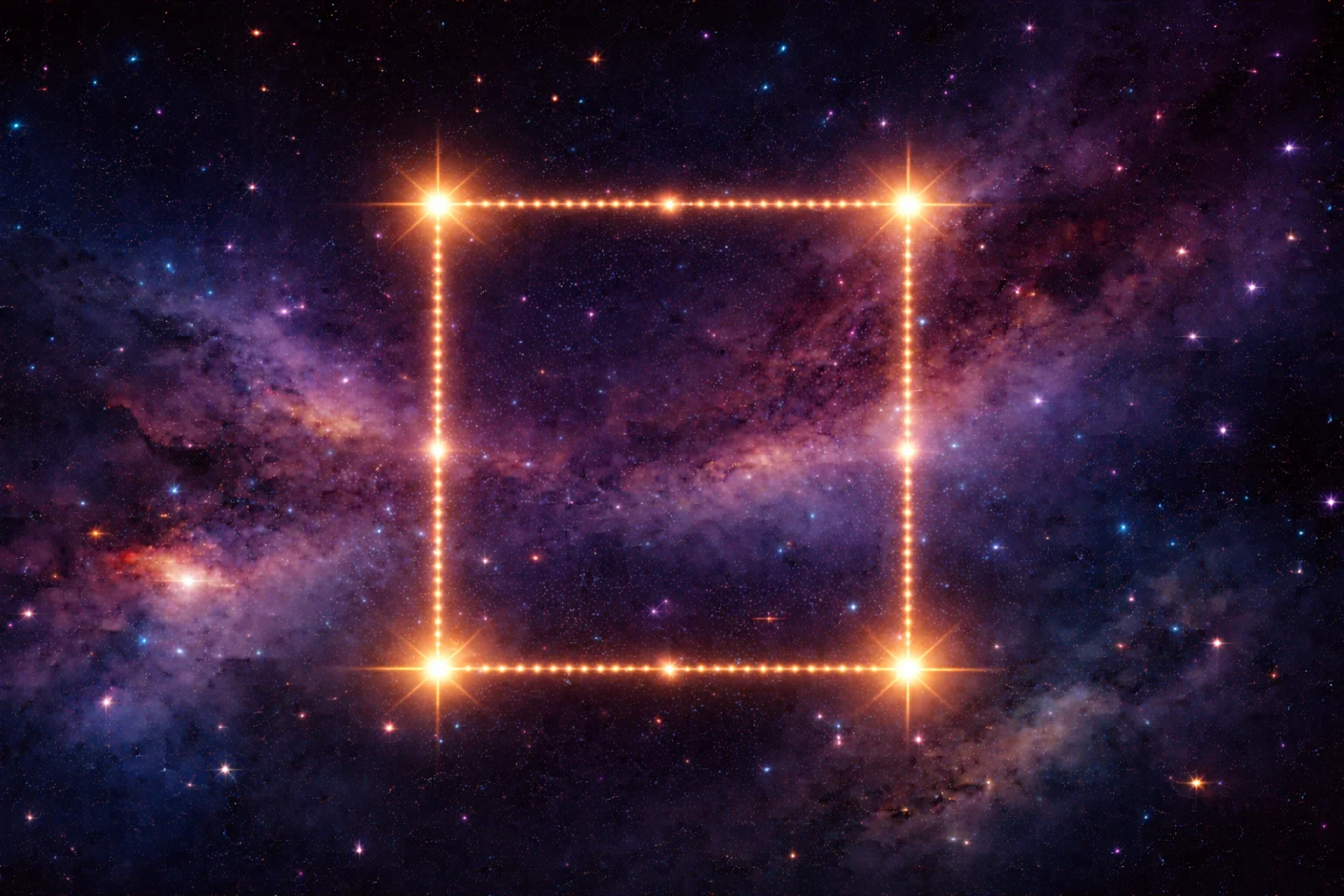
The square is a major aspect in astrology at 90 degrees, creating dynamic tension between planets that forces growth through friction. It shapes natal charts, transits, and synastry readings.
Last updated:
Two planets at right angles — friction, tension, and the pressure that forces you to grow.
The square is astrology's pressure cooker. When two planets sit 90 degrees apart, they create a right angle — a geometric relationship that refuses to be comfortable. Unlike trines that flow or sextiles that cooperate, squares push. They irritate. They demand that something change. And that is precisely why they are so valuable.
A square divides the circle by four, creating a relationship where both planets can see each other but cannot quite reach each other. They are not opposite enough to create the clear polarity of an opposition, not close enough to merge like a conjunction. They exist in a state of perpetual friction — like two gears that do not quite mesh but keep trying anyway. What makes squares particularly intense is the modality connection. Signs that square each other share the same modality: cardinal squares cardinal (Aries-Cancer-Libra-Capricorn), fixed squares fixed (Taurus-Leo-Scorpio-Aquarius), mutable squares mutable (Gemini-Virgo-Sagittarius-Pisces). They share a fundamental approach to life but express it through clashing elements. This creates internal conflict: both energies want to act the same way (initiate, persist, or adapt) but have completely different values and methods. It is like two people who both want to drive the car but disagree violently about the destination.
Here is astrology's lesser-known truth: squares are often more useful than trines. Trines create talent that comes so naturally you might never develop it. Squares create problems you have to solve. The person with Sun trine Saturn has natural discipline; the person with Sun square Saturn has spent decades building discipline through struggle — and often ends up with more of it. Squares do not let you coast. They create an internal itch that demands scratching. The tension is uncomfortable enough that you are motivated to do something about it — to develop skills, to confront problems, to grow in ways you never would if everything came easily. This is why some of the most accomplished people have challenging charts. The friction created purpose. The obstacles created strength.
A square feels like an internal argument that will not resolve. Two parts of you pull in different directions — not opposite directions, but perpendicular ones. There is friction, yes, but also energy. You cannot ignore a square. It keeps prodding you, annoying you, motivating you until you finally do something about it. The discomfort is real, but so is the power it generates. Living with a square feels like having an ongoing debate inside yourself. One part of you wants one thing; another part wants something that seems incompatible. Sun square Moon? Your identity conflicts with your emotional needs. Venus square Mars? Your desires fight with your ability to act on them. Mercury square Saturn? Your thoughts feel constantly judged or blocked. The key word is tension. Not suffering — squares do not doom you to misery. But a kind of productive discomfort, like the tension in a muscle that is growing stronger.
Squares cannot be eliminated or transcended — only integrated. The goal is not to make the tension disappear but to harness it productively. Think of a square like a bow and arrow. The tension between the string and the bow is what gives the arrow its power. Without tension, nothing moves. With skillfully applied tension, you can hit targets you never could otherwise. Integration means finding actions that satisfy both planets — or at least do not violate either one completely. It means recognizing that the conflict is between two legitimate needs, not between a good part of you and a bad part. Both planets in a square have something important to offer. Your job is to become the diplomat who helps them cooperate.
Acknowledge both planets. Neither one is the villain. Both represent legitimate needs. The conflict is real, but so is the possibility of synthesis. Find activities that honor both. If your Moon squares your Mars, find emotional outlets that involve action, or physical activities that feel nurturing. Use the friction as fuel. Squares create energy. Do not waste that energy on fighting yourself — channel it toward external goals. Accept that comfort is not the goal. A square will never feel as easy as a trine. That is fine. Ease is not the only valuable experience. Strength, resilience, and achievement also have value. Watch for projection. Before blaming external obstacles, ask yourself: Is this conflict really out there, or is it inside me? Often, resolving the internal tension makes the external obstacles evaporate.
The gift of the square is earned strength. Whatever you develop through its pressure becomes genuinely yours — not inherited talent but built capability. The muscles you develop by lifting weights are stronger than those you were born with. Similarly, the qualities you develop through square-generated struggle become the most reliable parts of your character.
Squares have a generous orb because they are major aspects. Tight orb (0-3 degrees) means the tension is unmistakable and constant. This square is a central life theme that you cannot ignore. Standard orb (3-8 degrees) is the classic square experience with clear tension, clear growth potential, clear need for integration. Wide orb (8-10 degrees) means the square is present but subtler. You feel the friction occasionally rather than constantly. Easier to live with, but also easier to ignore rather than integrate. For luminaries (Sun and Moon), many astrologers extend the orb to 10 degrees or even 12. For outer planets, some use tighter orbs.
Applying square means the faster planet is approaching the exact 90 degree angle. Tension is building. The pressure increases until the aspect perfects. Applying squares in natal charts feel urgent; there is something you are moving toward that demands resolution. Separating square means the exact aspect has passed; planets are moving apart. The crisis has peaked. Now you are in integration mode — learning from what happened, cleaning up, building on the breakthrough. In transits, the applying phase is when you feel the pressure mounting. The exact aspect is the peak. The separating phase is recovery and consolidation.
Squares are not bad. Squares are challenging, but challenge is not bad. Some of the most successful, interesting, accomplished people have square-heavy charts. The friction created their drive. Squares do not primarily mean conflict with others. They primarily represent internal conflict. External fights often mirror internal ones. Resolve the inner tension and the outer conflicts often decrease. You cannot truly transcend your squares. You can integrate them, work with them, use their energy constructively. But the basic tension remains throughout life. The goal is not elimination but mastery. Squares are not stronger than trines — they are different. Both are major aspects. Squares create difficulty; trines create ease. Neither is inherently better; it depends on what you do with them.
Traditional astrology classified the square as a hard or challenging aspect — one of the two major difficult aspects alongside the opposition. Ancient astrologers associated squares with difficulty, obstacles, and conflict. The term square itself comes from the Latin quadratura, referring to the four-sided figure created when you connect signs in square aspect around the chart. Medieval astrology emphasized the elemental clash: signs in square share no element, creating fundamental incompatibility. A fire sign squaring a water sign meant passion meeting emotion, initiative meeting receptivity — combinations that require work to harmonize. Modern psychological astrology has rehabilitated the square. Rather than simply bad, squares are now seen as growth aspects — difficult but developmental. The shift reflects a broader cultural movement from fate-based to growth-based thinking about life challenges. Still, even modern astrologers acknowledge: squares are hard. They are supposed to be. That is how they do their work.
Some of history's most driven individuals have been powered by squares. The tension created ambition; the friction created focus; the challenges created the very strengths they became known for. Squares appear prominently in the charts of athletes, entrepreneurs, artists, and anyone who has had to fight for what they achieved. Easy aspects might create potential; squares create necessity — and necessity, as they say, is the mother of invention.
Topics: tension, friction, challenge, growth, conflict, pressure, action, dynamic, crisis, breakthrough, motivation, drive
Driven, motivated, productive under pressure, resilient, action-oriented, refuses to accept the status quo, growth-focused, dynamic, achiever, develops real strength through challenge
Chronic tension, internal conflict that becomes external drama, self-sabotage, anxiety, frustration, combative nature, difficulty relaxing, creates problems to have something to solve
Natal squares are your personal training program. They show where life will repeatedly present you with challenges — not to punish you but to develop you. A natal square says: "These two parts of you are in tension. Your mission, should you accept it, is to find a way to make them work together." People with prominent squares often accomplish more than those with easier charts. The friction creates fuel. But they also have to be careful not to let the tension define them — to become so identified with struggle that they can't accept ease when it comes. The houses involved show WHERE the tension plays out. The planets show WHAT needs integration. The signs show HOW the conflict expresses itself. A thorough chart reading examines all three.
Transiting squares mark crisis points — moments when pressure builds until something has to give. When a transiting planet squares a natal planet, it activates that natal planet's issues in a challenging way. The transiting planet acts as a stress test, revealing where your structure is weak and where it needs reinforcement. The good news: transiting squares are temporary. The challenging period lasts only as long as the transit (days for the Moon, weeks for Mars, months for Saturn, years for the outer planets). And the growth that happens during a hard transit often outlasts the difficulty. Look at transiting squares as opportunities for targeted growth. The area of life being activated is the area ready for development — even if "development" temporarily feels like demolition.
Squares in synastry create chemistry — the complicated kind. When your planets square someone else's planets, there's friction between you. You irritate each other, challenge each other, push each other's buttons. This sounds negative, but many long-lasting relationships are held together partly by squares. They keep things interesting. The question with synastry squares is whether the friction is productive or destructive. Do you push each other to grow? Or do you tear each other down? The planets involved matter: Venus square Mars creates sexual tension that can be thrilling. Saturn square Sun creates a critical dynamic that can be grinding. Some square contacts are essential. Others are deal-breakers. Understanding which is which requires looking at the whole chart comparison.
| Oct 3, 2026today | □ | Mercury □ Pluto |
| Oct 3, 2026today | □ | Moon □ Sun |
| Oct 3, 2026today | □ | Moon □ Saturn |
| Oct 5, 2026in 2 days | □ | Moon □ Mercury |
| Oct 5, 2026in 2 days | □ | Moon □ Venus |
Every morning, we check where the planets are and tell you what it means. Not vague stuff — things you might actually notice today.
Not vague promises about 'growth opportunities.' Real themes. Real timing. What this year is actually about for you — and when it gets interesting.
Your birth chart, distilled into one shareable image. Dating roasts, personality callouts, compatibility scores. €1 each. Built for group chats.
Your cosmic blueprint revealed. See why you are the way you are — your patterns, strengths, and the themes that keep showing up in your life.