The Hierophant
The Hierophant represents tradition, spiritual guidance, and the wisdom passed down through established systems. Linked to Taurus and the element of Earth.
Last updated:
About The Hierophant
Learn the tradition deeply enough to know which parts to keep and which to outgrow.
There is a teacher in your life you did not choose. Maybe it is the culture you grew up in. The unwritten rules of your family. The way things are "just done" in your field. The Hierophant is that voice — not necessarily a person, but the entire weight of tradition, convention, and "this is how we have always done it." The fifth card of the Major Arcana, and it is more uncomfortable than most people think, because it asks a question nobody likes to answer: how much of what you believe did you actually choose — and how much was just handed to you?
The Figure Between the Pillars
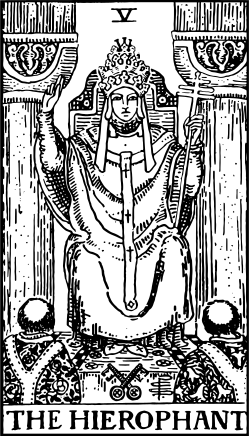
The classic image shows a religious figure on a throne between two grey pillars. Two students kneel before him. The crossed keys at his feet represent knowledge that is locked away — not accessible to everyone, only to those who walk the prescribed path. The triple crown signifies authority over three levels: body, mind, and spirit. The Hierophant is not a rebel. He is the system itself.
Unlike the Emperor, who wields worldly power, the Hierophant rules over meaning. He does not decide what gets done, but what it MEANS. He is the priest who blesses the marriage, the judge who interprets the law, the professor who determines what belongs in the canon. His domain is not action but interpretation. Not law but morality. Not rules but values.
Taurus and the Element of Earth
The Hierophant is linked to Taurus, which sounds surprising at first for a card associated with spirituality and teaching. But the Taurus part explains the most important aspect: the Hierophant is not about fleeting ideas or quick enlightenment. It is about what ENDURES. What has held up across centuries. What works not because it is exciting but because it is solid. Taurus energy is conservative in the original sense — it preserves what has value.
Earth as element makes the Hierophant practical. His spirituality is not the ecstatic connection with the divine — you find that more with Neptune. His spirituality is the everyday kind: the morning prayer, the meditation routine, the annual ritual. It is not about the single flash of insight but about the daily practice that builds wisdom over years. The Hierophant does not believe in shortcuts. He believes in the long road.
The Taurus-Earth combination also gives the Hierophant his stubbornness. He does not change his mind quickly, and that is both his strength and his weakness. The strength: in a world that chases every trend, he is the rock you hold onto. The weakness: in a world that is changing, he is the rock that stands in the way.
What the Hierophant Is Really Saying
When the Hierophant shows up, he is usually saying: there is a system here, a tradition, an established path that deserves attention. Not because everything old is automatically right, but because people before you have already thought about this problem and their solutions are worth hearing. The Hierophant says: before you reinvent the wheel, check if one already exists.
That can feel liberating — you do not have to figure everything out alone. There are mentors, teachers, systems, traditions that can carry you. The Hierophant says: find a teacher. Read the book. Take the course. There is a reason things are done the way they are done.
But it can also feel suffocating — especially when you are at a point where the old answers no longer fit. The Hierophant represents what society defines as "right," and sometimes what society defines as right is simply wrong. The hard part: figuring out which traditions carry you and which ones bury you.
When This Energy Goes Sideways
The Hierophant's shadow is dogmatism. The rule that becomes religion. The tradition that becomes a prison. The teacher who does not allow the student to surpass them. Whenever someone says "that is how it is done" without being able to explain why, you are experiencing shadow Hierophant energy. Whenever an institution puts its own rules above the people it should protect, that is the Hierophant in shadow.
Another shadow is false humility. The Hierophant who "serves the system" but actually uses the system to secure his own power. The guru who preaches devotion and drives a limousine. The boss who preaches teamwork and claims all the credit. The robe of tradition can hide real wisdom — or real corruption.
The Deeper Truth
The deepest teaching of the Hierophant is that you must understand tradition before you can break it. Rebellion without understanding is just noise. But tradition without questioning is just obedience. Mature Hierophant energy knows the rules so well that it knows which ones are worth keeping and which ones deserve to be broken.
The Hierophant also reminds you that you are not the first. Whatever you are going through — heartbreak, identity crisis, career crisis — millions of people before you have been through the same thing. And some of them wrote useful things about it. The Hierophant says: you are not as unique as you think. And that is comforting, not insulting. Because it means: there is help. There are paths. You do not have to find the way alone.
Topics: tradition, conformity, spiritual wisdom, guidance, institutions, education, belief systems, mentorship, orthodoxy, knowledge
In Readings
🔮In a Reading
When the Hierophant appears in a reading, he points to the importance of tradition, teaching, and proven paths. Sometimes he says: find a teacher. Sometimes he says: follow the established way — it exists for good reason. In life questions, he shows the area where shared values and common beliefs matter more than individual preferences. In specific decisions, he asks: what does the experience of those who walked this path before you say?
⚡When Active
When Venus, ruler of Taurus, touches the Hierophant area through strong transits, questions about values and belonging get loud. These are the phases when you ask whether your community — professional, spiritual, personal — still fits. Taurus transits are slow but deep. They do not demand immediate action but ask you to examine whether what you take for granted truly still holds up.
🤝In Combination
When the Hierophant appears beside other cards, he brings themes of tradition, shared values, and belonging. Next to the Fool, he shows the classic tension: tradition versus innovation, the established path versus the leap into the unknown. Next to the Devil, he raises the question of whether a tradition liberates or binds. In relationship questions, the Hierophant says: shared values matter more than shared interests. If the foundation matches, you can build on the rest.