Five of Cups
The Five of Cups confronts grief, regret, and the painful fixation on what spilled while two full cups still stand behind you. Mars in Scorpio, decan 1.
Last updated:
About Five of Cups
Three cups spilled, two still standing — turn around before you knock those over too.
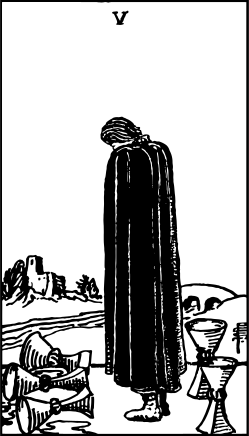
Three cups lie toppled on the ground, their contents seeping into the earth. Behind them stand two cups, upright and full — but the cloaked figure does not see them. Their gaze is fixed on what was lost. The Five of Cups is the card of grief, regret, and the painful fixation on what spilled while what remains stands unnoticed behind you. Mars in Scorpio, first decan: intense, cutting emotions that dig deep and refuse to let go.
This is one of the most honest cards in the tarot because it shows a universal human experience: the moment when loss looms so large that everything else becomes invisible. The failed relationship that blocks the view of everything good in your life. The missed opportunity that becomes an obsession. The mistake that keeps you awake at night. The Five of Cups does not say you should not grieve — it says that while you grieve, you must not forget what is still there.
Mars in Scorpio — pain with teeth
Mars traditionally rules Scorpio, and in the first decan of this fixed Water sign, its most destructive power shows. Where Mars in Aries is hot and quick — anger that flares and fades — Mars in Scorpio is cold and enduring. This pain does not let go. It bores, it digs, it turns grief into bitterness and regret into self-punishment. This is not the tear that flows and dries; this is the wound you keep reopening.
This Mars-Scorpio quality explains why the Five of Cups hits so hard. This is not mild disappointment but profound loss that gnaws at your identity. The Scorpio influence adds an obsessive quality: the repeated mental replay of what could have been. The inability to release the fallen cups even though their contents have long sunk into the ground. The perverse pull of pain that has become more familiar than joy.
Three lost, two remaining
The math of this card matters: three of five cups are lost. That is a majority. It feels like everything. But it is not everything — two cups still stand. And that is the lesson the Five of Cups preaches so stubbornly: loss is real, grief is justified, but the story is not over. As long as something stands, there is a foundation to rebuild on.
The difficulty lies in turning around. In the moment of loss, it feels like a betrayal to move on. Like a disrespect to what was lost. The Five of Cups understands that logic — and contradicts it anyway. Seeing the two standing cups does not mean denying the loss. It means accepting the complete truth: there is loss AND there is something that remains. Holding both at once is hard, but it is the only way through grief.
The bridge behind you
In many versions of this card, a bridge appears in the background — a path forward, waiting patiently. That is no accident. The Five of Cups is not a dead end. It is a valley that must be crossed, not an abyss to fall into. The bridge represents the possibility of recovery, of moving on, of starting over. But you have to turn around to see it.
Grief has no schedule. The Five of Cups does not demand that you immediately stand up and carry on. It only asks that at some point — when you are ready — you lift your head and see what is still there. The bridge will wait. The two cups will stand. But you have to choose to notice them.
The gift of loss
It sounds cynical to call loss a gift, but the Five of Cups contains an uncomfortable truth: some things needed to be spilled. Not everything that is lost was worth keeping. The toxic relationship that finally broke. The dream that was never truly yours. The illusion that held you captive. Sometimes the Five of Cups shows not tragic loss but painful, necessary release.
The Scorpio energy supports this reading: Scorpio is the sign of destruction and rebirth. What Mars in Scorpio tears down, it does not do out of malice — it does it because space must be made for something new. The three spilled cups may have been exactly the ones that needed to be empty so the two remaining ones can reveal their full worth.
When grief becomes a problem
The Five of Cups does not distinguish between healthy grief and problematic fixation — that is your job. Healthy grief moves through phases, shifts, changes. Problematic grief stays put, circles, defines the entire identity through loss. If after months or years you still only see the three fallen cups, if the pain has become a comfort zone, if you use the loss as an excuse to never risk anything again — then you are no longer in the Five. You have set up camp there.
The card itself is neutral — a portrait of a state, not a judgment. But it challenges you to be honest: are you still grieving, or are you clinging to pain because you are afraid of what comes next? The answer to that question determines whether the Five of Cups is a waypoint or a permanent address.
Topics: loss, grief, regret, disappointment, pessimism, mourning, focusing on loss, sadness, emotional pain, letting go
In Readings
🔮In a Reading
The Five of Cups in a reading shows you are processing a loss — or refusing to process one. The card acknowledges your pain but simultaneously asks you to see the full picture. Three cups have fallen, but two still stand. The question is not whether the loss is real — it is. The question is whether you are ready to also see what remains.
⚡When Active
Mars in Scorpio activates the first decan (0-9 degrees) of Scorpio. When planets transit through these degrees, the energy of the Five of Cups is stirred. Mars transits here intensify pain, anger, and the tendency to fixate on losses. Pluto transits demand deep emotional processing. Venus transits through this area can bring old relationship pain to the surface but also offer opportunities for healing.
🤝In Combination
In combination with other cards, the Five of Cups shows that unprocessed pain is burdening the connection to another person. That can mean past losses are overshadowing the current relationship, or that the relationship itself is a source of disappointment. Next to positive cards, it suggests healing is possible if both sides communicate honestly. Next to challenging cards, it warns against the danger of projecting old wounds onto new partners.