King of Swords
The King of Swords represents intellectual authority, moral clarity, and the disciplined mind that leads by thinking before it speaks. Fire of Air.
Last updated:
About King of Swords
He does not raise his voice — his words already carry the weight of someone who means every one.
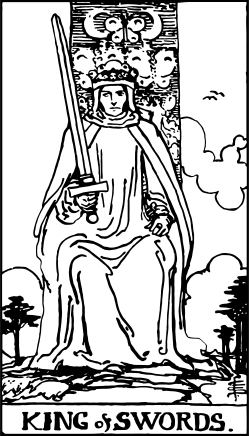
The King of Swords sits upright on his throne, sword in his right hand pointing upward — not to attack but as a symbol of authority. His gaze is calm, steady, evaluating everything and reacting to nothing. Fire of Air — passionate intellect, the flame that forges the steel of thought. He is the clearest head in the room and knows it without needing to prove it.
The Throne of Reason
The King of Swords does not rule through force, not through charm, not through emotional manipulation — he rules through the sheer superiority of his thinking. When he speaks, the room listens, not because he is loud but because every word lands. He does not argue — he states. He does not ask for agreement — he presents the logic and lets it speak for itself.
This makes him the natural judge, strategist, leader, and intellectual. He is the person you ask for advice when it really counts. Not because he tells you what you want to hear — that is exactly what he will not do — but because his judgment is unclouded by personal feelings. He sees the situation, not the emotions around it, and makes his decision based on facts, principles, and cold, clear logic.
Fire of Air: Passion of the Mind
The King's elemental combination is revealing. Fire (the King quality across all suits) brings willpower, drive, and passion to the Air element. This means: the King of Swords is not the cold, detached thinker he is sometimes portrayed as. He has fire — but his fire burns in the head, not the heart. He is passionate about truth, about justice, about intellectual excellence.
Fire of Air produces the demanding mind that tolerates no mediocrity — not in himself and not in others. The King of Swords holds himself to standards he set and expects the same from those around him. That can be inspiring — or suffocating, depending on whether you meet those standards.
Moral Authority
The King of Swords stands for a particular kind of leadership: moral leadership. He does not do what is popular but what is right. He renders judgments that are uncomfortable but just. He adheres to principles even when it would be easier to bend them. In a world full of opportunists and weathervanes, the King of Swords is the rock in the storm.
But moral authority has its price. The King can become dogmatic — so convinced of the rightness of his position that he stops listening. He can appear cold because he makes decisions that break hearts in the name of the greater good. And he can become lonely because few people want to share the intellectual solitude that comes with this kind of clarity.
The Discipline of Thought
What distinguishes the King of Swords from everyone else: discipline. Not the discipline of the body (that is the King of Pentacles) or the discipline of emotions (that is the King of Cups), but the discipline of the mind. He thinks before he speaks. He analyzes before he judges. He examines his own assumptions before questioning those of others.
This discipline makes him the most effective communicator in the tarot. His words carry weight because they are not spoken carelessly. When the King of Swords says something, he means it. When he is silent, that also has meaning. He wastes no energy on words that serve no purpose.
The King's Shadows
The King of Swords has shadows, and they are significant. Intellectual arrogance — the conviction of being smarter than everyone else and therefore having the right to rule over them. Emotional absence — so deep in the head that heart and body are neglected. Control — the need to steer everything and everyone through logic, including things that cannot be steered.
In his darkest form, the King of Swords becomes the cold manipulator who weaponizes intellect — not for justice but for power. The tyrannical boss, the brilliant narcissist, the manipulative partner who is always three steps ahead. The blade that should protect turns against those who need it most.
The Invitation to Mastery
At his best, the King of Swords is the wise judge, the fair leader, the brilliant thinker who puts his gifts in service of truth. He inspires through integrity, leads by example, and communicates with a precision that creates clarity where there was confusion. He is proof that intellectual strength and moral integrity are not opposites.
Topics: intellectual power, authority, truth, moral clarity, discipline, strategy, logic, fairness, command, analytical mind
In Readings
🔮In a Reading
The King of Swords in a natal reading shows someone with a natural authority that grows from intellectual strength and moral integrity. You are the clear thinker, the strategic planner, the person with incorruptible judgment. Your strength: you see the truth and have the courage to speak it. Your challenge: not sinking so deep into the head that you forget other people have hearts, not just heads.
⚡When Active
When transits activate King of Swords energy, your need for clarity, structure, and mental authority grows. You are capable of analyzing complex situations with unusual sharpness and making well-founded decisions. Use this phase for important negotiations, strategic planning, and any situation that requires a cool head.
🤝In Combination
In combination with other cards, the King of Swords brings an energy of intellectual authority and moral clarity to the dynamic. Next to relationship cards, he demands respect and intellectual equality. Next to emotional cards, he counsels against switching off the mind. Next to conflict cards, he offers the path to resolution through fairness, logic, and incorruptible judgment.